Eastern Montpellier Snake
Malpolon insignitus (Geoffroy Saint-Hilaire, 1827)
By Francisco Jimenez-Cazalla
Updated: 23/09/2012
Taxonomy: Serpentes | Psammophiidae | Malpolon | Malpolon insignitus
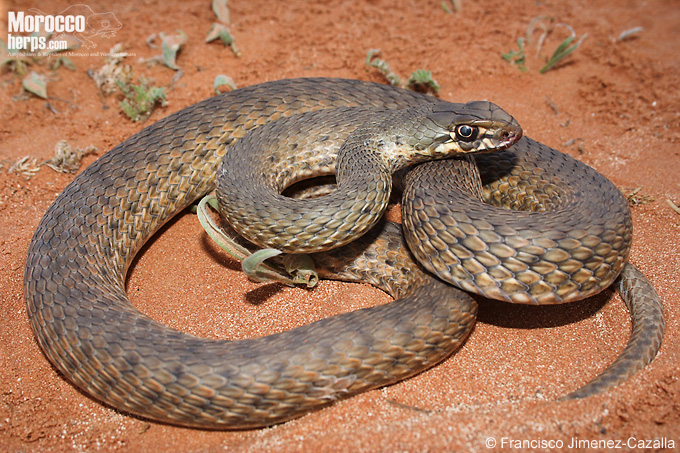
 Malpolon insignitus
 insignitus x monspessulanus
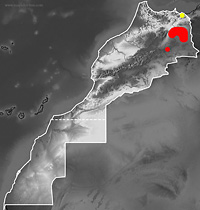
Distribution map of
Malpolon insignitus
in Morocco.
Gallery: 3 photos. [ENTER]
Description
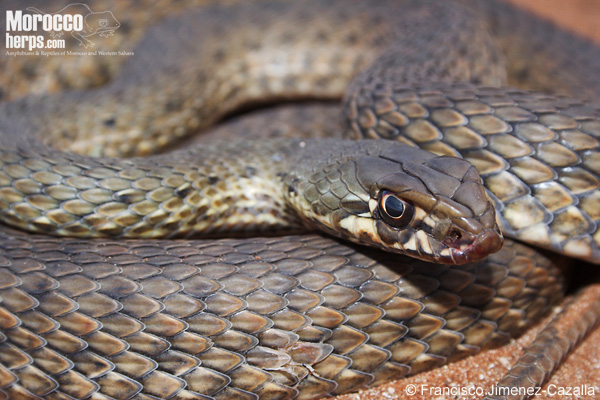
This snake, treated here as valid species (Carranza et al., 2006)1, presents, as expected, almost identical features with Malpolon monspessulanus. In contrast to this, there´re no records of more than 200 cm individuals, the largest individual known is cited by Anderson in Egypt reached 182 cm total length (Baha El Din, 2006).
Head narrow, poorly differentiated from the body and somewhat pointed. Previous supraocular and supranasal areas are somewhat prominent, highlighted by a visible depression in the loreal region. Ophistoglyph. Scale front close. 8 supralabials, the most with the 4th and 5 in contact with the eyes; these are large and with round pupil. Generally 2 postocular and 2 loreal scales. Just 1 preocular with big size, sometimes somewhat fragmented.
Body large, robust, covered with smooth and grooved scales longitudinally more or less obvious; these are arranged in rows 17-19 at midbody. According to Gruber (1993), M. insignitus normally has 17 rows, while M. monspessulanus usually has 19; this character is observed in Moroccan individuals (Fahd & Pleguezuelos, 2001; Jiménez-Cazalla obs. pers.). Usually 166-177 ventrals and 93-102 pairs of subcaudal scales. Anal divided.
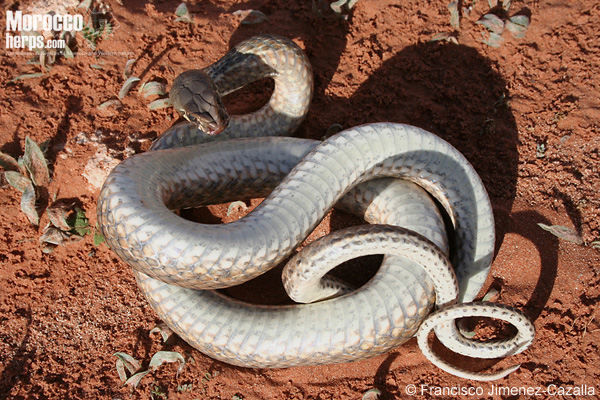
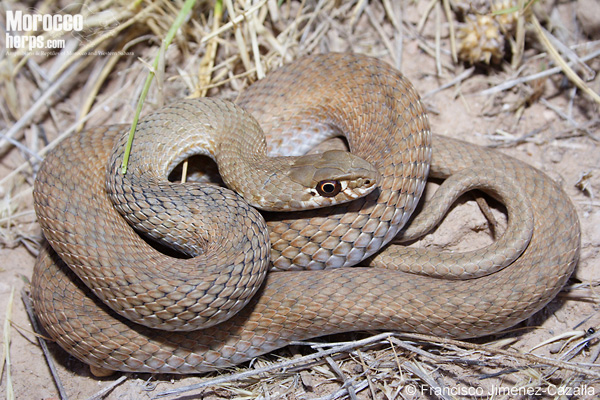
Males have a uniform dorsal coloration usually greenish, gray-green or brownish. They lack the classic black spot on the anterior body present in M. monspessulanus (Mertens, 1925; Lanza & Bruzzone, 1960). Belly white, cream or light yellow, and may present a more or less patent mottled. Juveniles and females with more contrast coloration, showing a pattern of dark spots on lighter background, the ventral coloration is cream or orange, with clear mottled.
Ecology and habits
Predominantly terrestrial and diurnal species, but noted an increase in crepuscular and nocturnal activity during the hottest months (Schleich et al., 1996; Baha El Din, 2006).
In the region of Oran is active for most of the year, and it has been observed in the months of November and February (Schleich et al., 1996).
We didn´t find specific data on reproduction and nutritional spectrum of this taxon in the literature, so the data presented below are those referred by Schleich et al. (1996) to M. monspessulanus in northern Africa.
Mating season is in the months from april to june, egg-laying from June to August; the size of this varies from 4-18 eggs. Hatchlings measure between 22-44 cm.
Their food spectrum is quite broad. Juveniles often feed small lizards (Chalcides, Acanthodactylus), anfisbaenians (Blanus, Trogonophis) and baby mammals. Adults prey on large lizards (Agama), snakes (including of the same species), mammals (Meriones), lagomorphs and birds (Alectoris, Galerida).
It has a great agility of movement and can run at high speed in danger. In case you get cornered it usually it breathes air to produce a loud snort of intimidating character, if it is attacked or subjected not hesitate to bite fiercely. This species isn´t considered dangerous to humans because it doesn´t usually bite with back teeth, the only able teeth to inoculate their weak venom. In most known cases of poisoning were observed only local symptoms such as edema, paresthesia, stiffness of the affected limb and lymphangitis, symptoms that disappear within 48 hours after application of antihistamines and corticosteroids (Pleguezuelos, 1997). Schleich (1987) mentions a fatal case of snake bite in Libya, although he didn´t see directly the event (Schleich et al., 1996; Fahd & Pleguezuelos, 1997).
Distribution, habitat and abundance
Present in the country’s easternmost area, east of the Oued Muluya. Most records are from the highlands region, where it seems to be rare; it´s presence to south decreases as it enters in desert domain (Bons & Geniez, 1996; Fahd & Pleguezuelos, 2001).

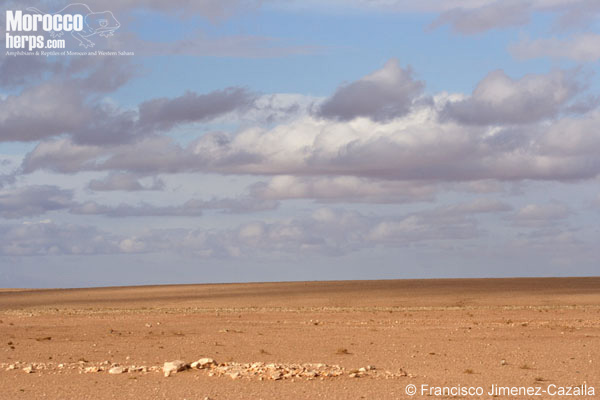
Generalist species but their distribution in Morocco is mainly steppe areas, both espart areas (Stipa tenacissima), and other low vegetation cover and variable stoniness.
___________________
- Carranza in this paper establishes the existence of two clades, a western clade (M. monspessulanus) and an eastern clade (M. insignitus insignitus and M. insignitus fuscus), but assigns the populations of Morocco and Algeria to the western clade.
References
- Baha El Din, S. 2006. A Guide to the Reptiles and Amphibians of Egypt. The American University in Cairo Press. New york.
- Bons, J. & Geniez, P. 1996. Anfibios y Reptiles de Marruecos (Incluido Sahara Occidentales). Atlas Biogeográfico. Asociación Herpetológica Española. Barcelona.
- Carranza, S., Arnold, E.N. & Pleguezuelos, J.M. 2006. Phylogeny, biogeography, and evolution of two Mediterranean snakes, Malpolon monspessulanus and Hemorrhois hippocrepis (Squamata, Colubridae), using mtDNA sequences. Molecular Phylogenetics and Evolution 450 (2): 532-546
- Fahd, S. & Pleguezuelos, J.M. 2001. Los Reptiles del Rif (norte de Marruecos), II: Anfisbenios y ofidios. Revista Española de Herpetología, 15: 13-36
- Geniez, P., Cluchier, A. & de Hann, C.C. 2006. A multivariate analysis of the morphology of the colubrid snake Malpolon monspessulanus in Morocco and Western Sahara: biogeographic and systematic implications. Salamandra, 42 (2): 66-82
- Gruber,U. 1993. Guía de las serpientes de Europa, Norte de África y Próximo Oriente. OMEGA
- Pleguezuelos, 1997. Malpolon monspessulanus (Hermann, 1804). En: Reptiles. Salvador, A. (coordinador, 1997. Fauna Ibérica, vol 10. Ramos, M.A. et al. (Eds). Museo Nacional de Ciencias Naturales. CSIC. Madrid; 408- 427.
- Schleich, H.H., Kästle, W. & Kabisch, K. 1996. Amphibians and Reptiles of North Africa. Biology, Systematics, Field Guide. Koeltz Scientific Books.
To cite this page:
Francisco Jimenez-Cazalla (2012): Malpolon insignitus (Geoffroy Saint-Hilaire, 1827). In: Martínez, G., León, R., Jiménez-Robles, O., González De la Vega, J. P., Gabari, V., Rebollo, B., Sánchez-Tójar, A., Fernández-Cardenete, J. R., Gállego, J. (Eds.). Moroccoherps. Amphibians and Reptiles of Morocco and Western Sahara. Available from www.moroccoherps.com/en/ficha/Malpolon_insignitus/. Version 23/09/2012.
To cite www.morocoherps.com en as a whole:
Martínez, G., León, R., Jiménez-Robles, O., González De la Vega, J.P., Gabari, V., Rebollo, B., Sánchez-Tójar, A., Fernández-Cardenete, J.R., Gállego, J. (Eds.). Moroccoherps. Amphibians and Reptiles of Morocco and Western Sahara. Available from www.moroccoherps.com.